


The Little Book Of Microcars
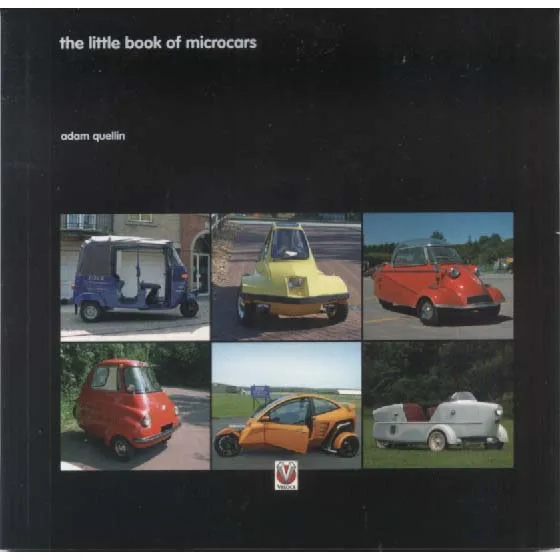
Publisher: Veloce Publishing
Format: Paperback
ISBN: 9781845842789
The Little Book of Microcars (2010) – Adam Quellin
Veloce Publishing | ISBN: 9781845842789
Condition: As New | Sold by Crappy Old Books
Microcars. Those wonderfully eccentric little machines produced when somebody looks at an ordinary motor car and decides that it contains an entirely unnecessary quantity of metal, horsepower, passenger accommodation and dignity. Why have four comfortable seats, a substantial engine and respectable luggage space when you could squeeze into something resembling a motorised biscuit tin, struggle heroically up a modest incline and attract more attention than a Rolls-Royce parked outside Buckingham Palace?
Welcome to The Little Book of Microcars, Adam Quellin’s delightful celebration of the smallest, strangest and most endearing automobiles ever to escape from the drawing boards of enthusiastic engineers.
The microcar phenomenon flourished particularly during the years following the Second World War, when much of Europe was recovering from economic devastation, petrol was expensive and ordinary families desperately needed affordable transport. Manufacturers responded with a remarkable assortment of tiny vehicles that offered the exciting possibility of staying dry while travelling, provided it wasn’t raining too heavily.
From the unmistakable bubble-shaped BMW Isetta to the Messerschmitt KR200, Heinkel Kabine, Peel P50 and assorted three-wheeled contraptions, the microcar world produced some of the most imaginative solutions to personal transportation ever devised.
The Isetta, famously entered through a door at the front, demonstrated that conventional automotive design was clearly suffering from a regrettable lack of imagination. Why waste valuable space fitting doors on the sides when the entire front of the vehicle could simply swing open?
The Messerschmitt, meanwhile, looked suspiciously like a fighter aircraft that had suffered a dramatic reduction in ambition. Its tandem seating, aircraft-inspired canopy and tiny engine offered an unforgettable motoring experience, particularly for anyone who had previously enjoyed the relative security of a conventional family saloon.
Then there was the Peel P50, a vehicle so small that finding a parking space became almost entirely optional. Indeed, one could practically carry the thing indoors, which presumably made explaining to the wife why there was a car in the hallway an interesting domestic challenge.
Quellin explores the extraordinary variety of these miniature machines, celebrating their ingenuity, unconventional engineering and irresistible visual charm. Some were practical responses to post-war austerity, others were ambitious commercial experiments, and a few appeared to exist principally because somebody had discovered an unused lawnmower engine and developed ideas above its station.
Naturally, microcars were not always particularly comfortable, fast or reassuring in heavy traffic. But they represented a fascinating period of automotive experimentation, when ingenuity frequently mattered more than performance and individuality was practically guaranteed.
Published in 2010 by Veloce Publishing, this compact volume is a charming introduction to a world of motoring where small really was beautiful, although occasionally rather cramped.
This 2010 edition, offered in As New condition by Crappy Old Books, is an appealing acquisition for classic car enthusiasts, collectors of unusual vehicles and anyone fascinated by the gloriously eccentric history of European motoring.
A delightful tribute to the bubble cars, three-wheelers and miniature marvels that proved automotive enjoyment need not be measured in horsepower, luxury or physical dimensions.
Because while modern manufacturers compete to produce ever larger vehicles with enormous wheels and increasingly complicated electronics, the humble microcar offers a refreshingly different philosophy.
Why take up two parking spaces when you could fit your entire motor car into one?
Possibly with room left over for the lawnmower.
Keep browsing: See more Transport books Other books by Adam Quellin
